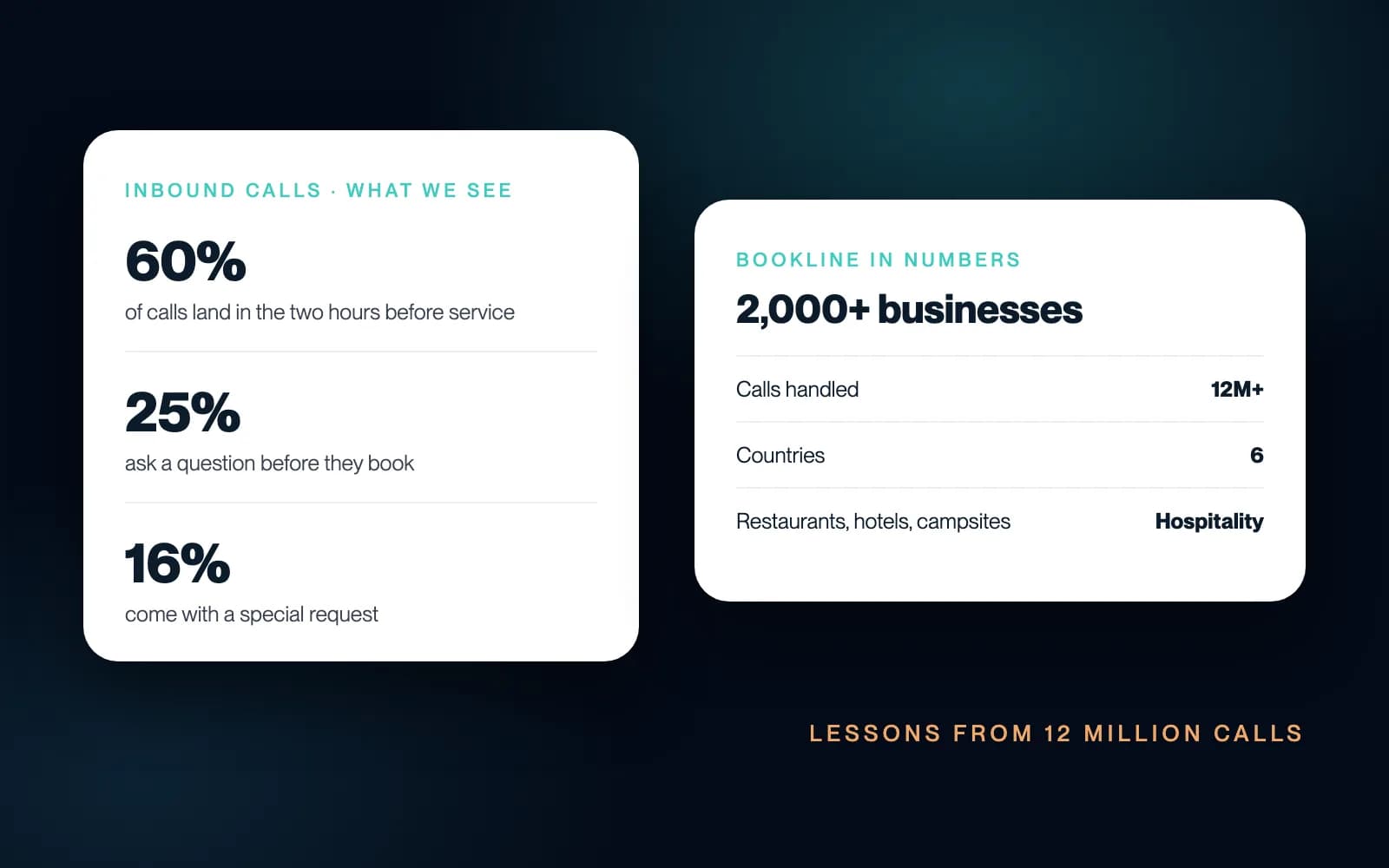
Bookline's AI agents answer the phone for more than 2,000 hospitality businesses in six countries: restaurants, hotel groups, campsites and hostels in Spain, Italy, France, Portugal and Latin America. Together they have handled more than 12 million calls.
That is a lot of people asking for a table at nine, a room with a crib or a pitch near the pool. Listen to enough of those calls and the same patterns keep showing up, whatever the country, the cuisine or the size of the venue. This article collects the eight we would tell any operator about before they decide how to handle their phone, including operators in the United States.
Where these numbers come from
Every figure in this article comes from calls answered by Bookline's voice agents for our own customers, or from the published success cases of those customers. We have not mixed in third-party surveys: when we say 60%, it is 60% of the calls we actually answered.
Two caveats. First, our base is mostly Southern European and Latin American, and mostly restaurants, so the numbers describe those guests. Second, a business that hires an AI agent is usually one that has a phone problem in the first place, so our sample leans towards busy venues. Neither caveat changes the patterns below, but both are worth keeping in mind when you compare them with your own.
8 lessons about phone reservations
In rough order of how much money they move.
1. The phone rings when nobody can answer it
60% of calls arrive in the two hours before service. That is when the team is setting tables, briefing the floor, seating the first covers and, in a busy room, running.
This is the single most important number in this article, because it explains why so many calls go unanswered in venues that are perfectly well run. It is not a staffing failure or a lack of manners: the demand for the phone peaks at exactly the moment the people who could answer it are needed somewhere else. Adding a second phone line does not help. Answering on the first ring, whatever is happening on the floor, does.
2. Callers are guests you have not met yet
80% of the people who call have never contacted the venue through any other channel. They have not booked online, they have not messaged, they are not on your list. The phone is their first touchpoint.
That makes an unanswered call more expensive than it looks. A regular who gets voicemail tries again later. A first-time caller who gets voicemail tries the next restaurant on the map, and you never find out they existed.
3. A quarter of callers want an answer before they want a table
In 25% of calls, the guest asks a question before starting the booking. Is there parking? Can we bring the dog? Do you have gluten-free options? Is the patio heated? Is there a corkage fee?
The practical consequence is that a phone agent that can only take reservations is solving three quarters of the problem. If it cannot answer the question, the guest does not get to the booking. Whatever handles your phone, human or AI, needs your real answers to the twenty questions people actually ask.
4. One booking in six comes with something special
16% of reservations include a special request: a birthday cake, candles, a high chair, an allergy, a quiet table for a proposal, a wheelchair. These are the bookings that turn into reviews, good or bad, depending on whether the note reached the kitchen.
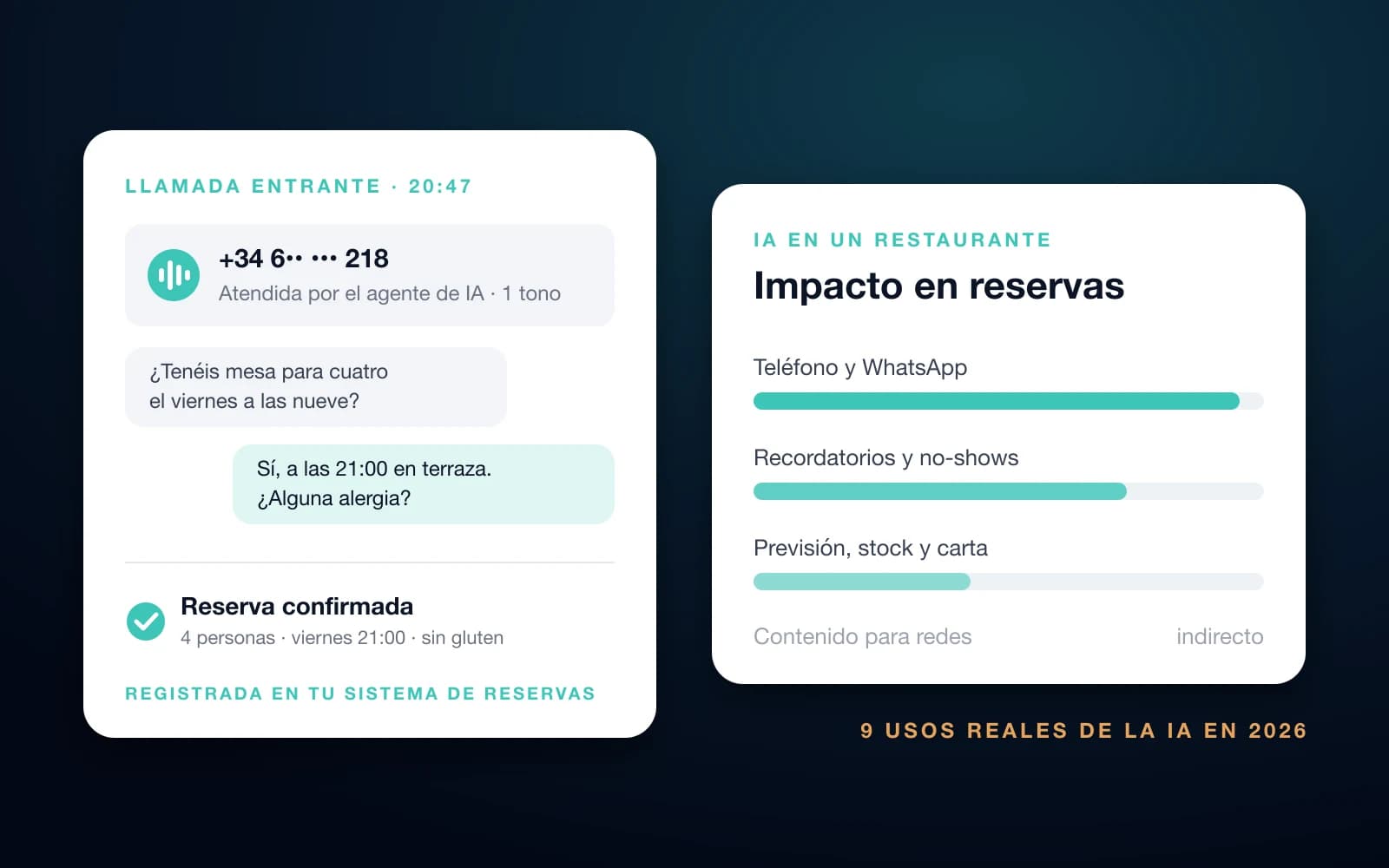
The lesson: capturing the request is not enough. It has to land in the reservation itself, in the system the team reads before service, not in a notebook by the phone.
5. Peaks mean several calls at once
When 60% of the calls squeeze into two hours, they do not arrive politely one after the other. They overlap. A person can hold one conversation; the second caller hears it ring out or gets put on hold, and a lot of people hang up on hold.
This is where software changes the arithmetic rather than just the cost: an AI voice agent takes every simultaneous call at the same time, with no queue. In the Grupo Ceviche case, a Peruvian restaurant group in Spain with seven brands, that meant 15,071 calls answered and 344 hours of phone time handed back to the team, with an estimated €312,060 in value delivered.
6. Guests change language without warning
In tourist cities, the same morning brings calls in Spanish, English, French, German and Italian, often to a venue whose team speaks two of those well. Guests do not announce their language in advance and they do not adjust to yours.
Our agents detect the caller's language and answer in it, and the booking lands in the reservation system like any other. That matters more than it sounds: a guest who is answered in their own language gives better information (the allergy, the arrival time, the name spelled right) because they are not struggling to explain it.
7. The reservation book has to be the single source of truth
The worst setup we see is the one where phone bookings live somewhere different from online bookings: an outsourced call center that emails reservations, a paper diary next to the host stand, a shared spreadsheet. Grupo Ceviche had tried exactly that before Bookline: an outsourced service that took bookings by phone and sent them by email. Slow, error-prone, and nobody knew the real availability.
An agent is only as good as its access to real availability. Ours read and write directly in the reservation system the venue already uses, so a table booked by phone disappears from online availability in the same second. Ask to see the integrations before you ask to hear the demo voice.
8. The team notices the silence more than the bookings
When we ask customers what changed, they rarely lead with the revenue. They talk about the noise. "The staff stopped feeling that anxiety caused by the phone when it rings incessantly," is how La Prosciutteria's operations manager put it, after 6,361 calls were answered for the Italian group and 108 hours of phone time came off the team.
That is not a soft benefit. In a tight labor market, a floor team that is not interrupted every four minutes is a team that serves better and stays longer.
See what your phone is missing
We'll show you how a Bookline agent answers your calls, checks real availability and books into the system you already use.
Book a demoWhat travels to the US, and what does not
Most of these lessons are structural rather than cultural. Dinner has a peak, the peak overlaps with service, first-time guests call, people ask before they book, and birthdays exist everywhere. We would expect lessons 1 to 5, 7 and 8 to hold in an American restaurant with very little change.
What will differ:
- Online share. Online reservation platforms are more widespread among US restaurants than in much of Southern Europe, so the phone may carry a smaller share of bookings. That makes the remaining calls more concentrated on the cases online cannot handle: large parties, same-day requests, questions and changes.
- The language mix. Instead of five European languages in a tourist town, a US restaurant is more likely to get English and Spanish all day, every day. That is a different problem, and in some cities a bigger one.
- The clock. Dinner in Madrid peaks around 9:30 PM; in most US cities, hours earlier. The two-hour window before service exists in both; it just sits at a different time.
We have not yet answered phones for US restaurants at scale, so treat this section as an informed expectation, not a measurement. When there is American data worth publishing, we will publish it.
How to check your own phone in a week
You do not need an AI agent to find out whether you have this problem. For one week:
- Pull the call log from your phone provider and count missed and abandoned calls by hour. Most VoIP systems show this.
- Overlay it with your covers by hour. If the missed calls cluster in the two hours before service, you are looking at lesson 1.
- Ask the host stand to tally the questions they answer by phone. If the same ten come up again and again, that is lesson 3.
- Put a number on it with the missed-calls calculator: missed calls × the share that would have booked × average party size × average check.
If the number is small, keep doing what you are doing. If it is not, the AI voice agent is the shortest path we know to answering every call.
Frequently asked questions
The questions operators ask us most about these numbers.
Which six countries does Bookline work in?
Spain, Italy, France and Portugal in Europe, plus Latin America. Spain is our largest market.
Are these numbers from restaurants only?
The four call patterns (60% before service, 80% first contact, 25% questions first, 16% special requests) come from restaurant calls. The overall base of more than 2,000 businesses and 12 million calls also includes hotels, campsites and hostels.
Does an AI phone agent replace the host?
No. It takes the calls the host cannot take, at the moments the host is busy with the guests in front of them, and transfers the call with a summary when a person is genuinely needed.