AI for restaurants is software that takes over tasks that used to need a person standing by: answering the phone, replying to a WhatsApp, reminding a guest about a booking, responding to a review, predicting how many covers you'll do on Saturday. In 2026 it is no longer an experiment: some uses are mature, get set up in days and show up in the till; others are still more promise than result.
If you've searched for "AI for restaurants", you've seen the lists of twelve, sixteen or twenty tools. The trouble with those lists is that they put an Instagram photo generator on the same level as a system that answers the phone during lunch service. They are not worth the same. This guide goes through the nine uses that genuinely work today, ranks them by impact and tells you where to start.
What AI for restaurants is, in one sentence
It's technology that understands language or spots patterns in data, which a restaurant uses to hand off repetitive work or to make better decisions. Almost everything on sale today falls into one of three families:
- Conversational AI: talks to your guests. Voice agents that answer the phone, WhatsApp assistants, website chat. This is the one that touches bookings directly.
- Predictive AI: looks at your historical data and anticipates. Footfall forecasts, purchasing, staff rotas, pricing.
- Generative AI: produces text or images. Review replies, dish descriptions, social media posts.
The distinction matters because each family needs different things to work. Conversational AI needs to be connected to your booking system. Predictive AI needs clean POS and booking data (if you don't have it, it predicts nothing). Generative AI needs someone to check what it writes.
The 9 uses of AI in restaurants that already work
Ranked from most to least direct impact on revenue for a table-service restaurant.
1. Answering the phone and taking bookings
This is the use with the clearest return, for a simple reason: the phone rings exactly when nobody can pick it up. In the call data Bookline handles, 60% of calls come in the two hours before service, which is precisely when the team is setting up, seating the first guests or already swamped.
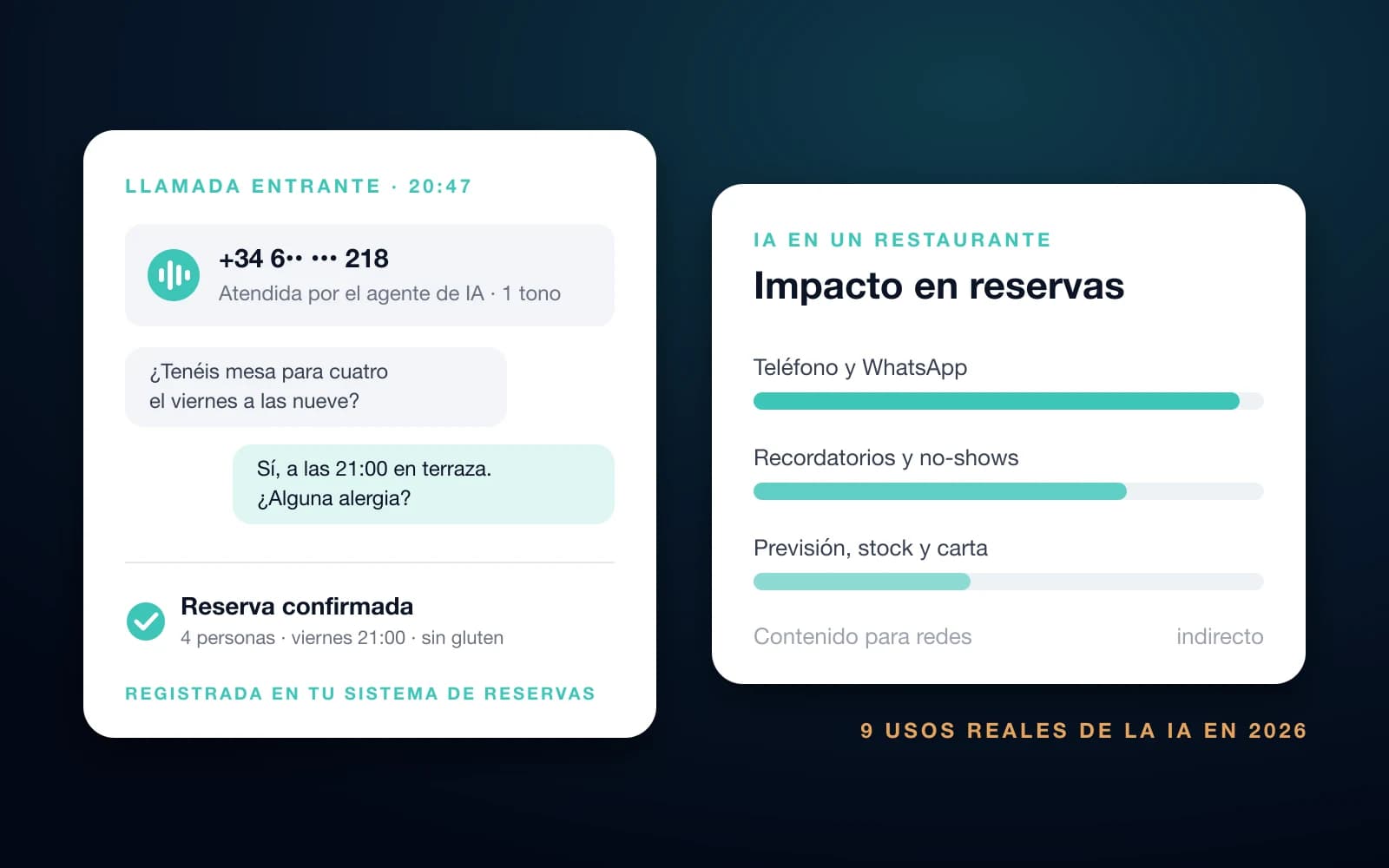
An AI voice agent answers on the first ring, at any hour, and takes every call at once. It isn't a voicemail or a "press 1" menu: it holds a normal conversation, checks real availability in your booking system, offers another time if there's no table, notes allergies or a birthday cake, and logs the booking without anyone on the team typing it in. When the guest needs a person, it transfers the call along with a summary of what's already been said.
The Grupo Ceviche case sums it up: more than 15,000 calls answered and an estimated €312,000 in value delivered, at a group where, in its founder's words, the team "had to choose between the phone and the table".
2. Bookings and questions over WhatsApp
A growing share of your guests would rather type than call, especially to book outside opening hours or ask something quick. An AI assistant on WhatsApp answers instantly about opening times, the menu, the terrace or parking, and closes the booking in the same conversation.
The difference from a fixed-reply chatbot is that it understands questions however they're phrased and in any language, and it knows when it shouldn't answer and should pass the message to the team instead.
3. Confirmations and reminders against no-shows
An empty table that was booked costs the same as a missed call, just later. AI sends a confirmation when the booking is made and a reminder before the visit, and the most useful part: it lets the guest cancel or change the time by replying to the message, so the table is free again in time to sell it twice.
How to reduce no-shows in your restaurant covers which messages to send and when.
4. WhatsApp marketing campaigns to fill quiet days
Tuesday lunch doesn't fill itself. Using the guests who have already booked with you, AI can segment (who came in for their birthday, who hasn't been back in three months, who always asks for the terrace) and send WhatsApp marketing campaigns that get read within minutes, not days like an email.
If you want to see what works, WhatsApp marketing campaigns for restaurants has concrete examples.
5. Replying to reviews
Generative AI drafts a reply to every Google or TheFork review in seconds, tailored to what the guest said and in their language. It saves time and means no review goes unanswered, which is what the next guests see.
The caveat: a generic reply to a specific complaint is worse than no reply at all. Treat it as a draft and check the negative ones before posting.
6. Demand forecasting and staff rotas
By combining bookings, sales history, the calendar and even the weather, predictive models estimate how many covers each service will do. That lets you adjust front-of-house and kitchen rotas, avoiding both the short-staffed Saturday and the overstaffed Monday.
It works well for groups with several sites and years of data. For an independent restaurant whose booking system and POS don't talk to each other, the results are far more modest.
7. Stock, purchasing and waste
The same principle applied to the kitchen: if you know how many covers are coming and what people usually order, you know how much to buy. Some kitchen management and POS systems already suggest supplier orders and flag products that are about to stop moving. It's one of the areas where the most money leaks away unseen, but it depends entirely on the inventory being up to date.
8. Menu and pricing
AI analyses which dishes sell, what margin they leave and how they're ordered together, and suggests what to feature, what to reprice and what to drop. It's classic menu engineering, done with more data and faster. Before you ask it for anything, you need to know what each dish costs you: restaurant recipe costing explains how to work it out, and AI for menus and pricing how to apply it afterwards.
9. Content for social media and the website
Dish descriptions, Instagram captions, menu translations, touching up photos taken on a phone. It's the most visible use and the easiest to try (many tools are free), but also the one that translates least into bookings on its own. A great post doesn't do much if the person who sees it calls and nobody picks up.
Where to start: the use that pays for itself
If you're only going to roll out one thing this year, make it the one that looks after guests who already want to book. The reasoning is simple arithmetic:
- The demand already exists: that person has looked up your restaurant, decided to come and is dialling your number. There's nothing to convince them of.
- Right now some of those calls go unanswered, and a guest who can't book doesn't leave a message: they call the next restaurant on the list.
- Conversational AI doesn't need years of data or a new system: it connects to your booking tool and works from day one.
Demand forecasting, stock and menu engineering are real levers, but they work on margins. Guest service works on revenue that currently isn't coming in at all.
To put a figure on your own case, the missed-call calculator estimates how much slips away based on your call volume and average spend.
How to choose AI for your restaurant: 6 questions
Before you sign with anyone, these are the questions that separate a slick demo from something that holds up on a Saturday night:
- Does it integrate with my booking system? If the agent doesn't read and write in real time to TheFork, CoverManager, Restoo or whatever you use, you'll end up with two diaries and someone copying bookings across by hand. Ask to see the list of integrations.
- How many conversations can it handle at once? Call volume peaks right before service. If it takes one call and puts the rest on hold, you haven't solved anything.
- Which languages does it understand? If you have international guests, it should detect the language on its own and reply in it, without making the caller choose from a menu.
- What happens when it doesn't know something? It should transfer to a person with the context, not make up an answer or hang up.
- Does it charge a commission per booking? An AI answering your own phone shouldn't take a cut of your direct guests.
- Is it compliant? The EU AI Act requires guests to know they're talking to an AI, and booking data is personal data. The AI Act in hospitality sets out what you should demand.
What Bookline does, and what it doesn't
Bookline is a conversational AI platform for hospitality: it covers uses 1 to 4 on this list, the ones that talk to your guests.
- Voice agent: answers every call at once, 24 hours a day, in the guest's language, and handles bookings, changes, cancellations and frequently asked questions.
- WhatsApp assistant: the same bookings and questions, in writing.
- Confirmations, reminders and WhatsApp marketing campaigns: to cut no-shows and fill quiet services.
- Direct integration with the main booking systems in the industry, so everything lives in a single diary.
What it doesn't do: it doesn't manage your stock, it isn't a POS and it doesn't replace your booking system; it works on top of it. For purchase forecasting or menu engineering you'll need other tools, ideally ones that can talk to the ones you already have.
The Italian group La Prosciutteria, for example, started with the phone: more than 6,300 calls answered and 108 hours of phone time the team no longer had to spend on it. You'll find this and other results in success stories, and the product details for restaurants in AI for restaurants.
Frequently asked questions
What restaurants ask most before taking the plunge.
Does AI replace front-of-house staff?
No. It replaces the part of the job staff do grudgingly and badly for lack of hands: answering the phone with a tray in the other hand, repeating the opening hours twenty times a day, jotting bookings on a scrap of paper. The team stays on the floor, which is where it adds value.
How much does AI cost for a restaurant?
It depends a lot on the use. Generative tools for social media or reviews have free versions or cost a few euros a month. A voice and WhatsApp agent integrated with your bookings depends on call volume and number of sites, so the sensible thing is to ask for a quote based on your numbers. With Bookline there's no commission per booking: you can request a demo and we'll work it out for you.
Do I have to change my booking system?
You shouldn't. A good conversational AI connects to the system you already use and writes to it. If a tool asks you to migrate your diary to work, that's a signal to ask why.
Does it understand foreign guests and accents?
Today's voice agents detect the language from the first sentence and handle accents and background noise reasonably well. It's one of the areas where the difference is most noticeable compared with a team that answers in one or two languages.
Is it legal for an AI to talk to my guests?
Yes, on two conditions: the guest must know they're talking to an AI, and the data must be handled in line with the GDPR. Any serious provider takes care of this by default; it's still worth asking.
In short
AI for restaurants isn't a single tool or a fad: it's a set of uses with very different returns. Generative ones are cheap and eye-catching; predictive ones are powerful if you have the data; conversational ones are the first to show up in your bookings, because they win back guests who already wanted to come.
If you want to dig into that last one, the guide to AI phone answering for restaurants explains how the agent works under the hood, and what a virtual receptionist is compares your options for the phone.