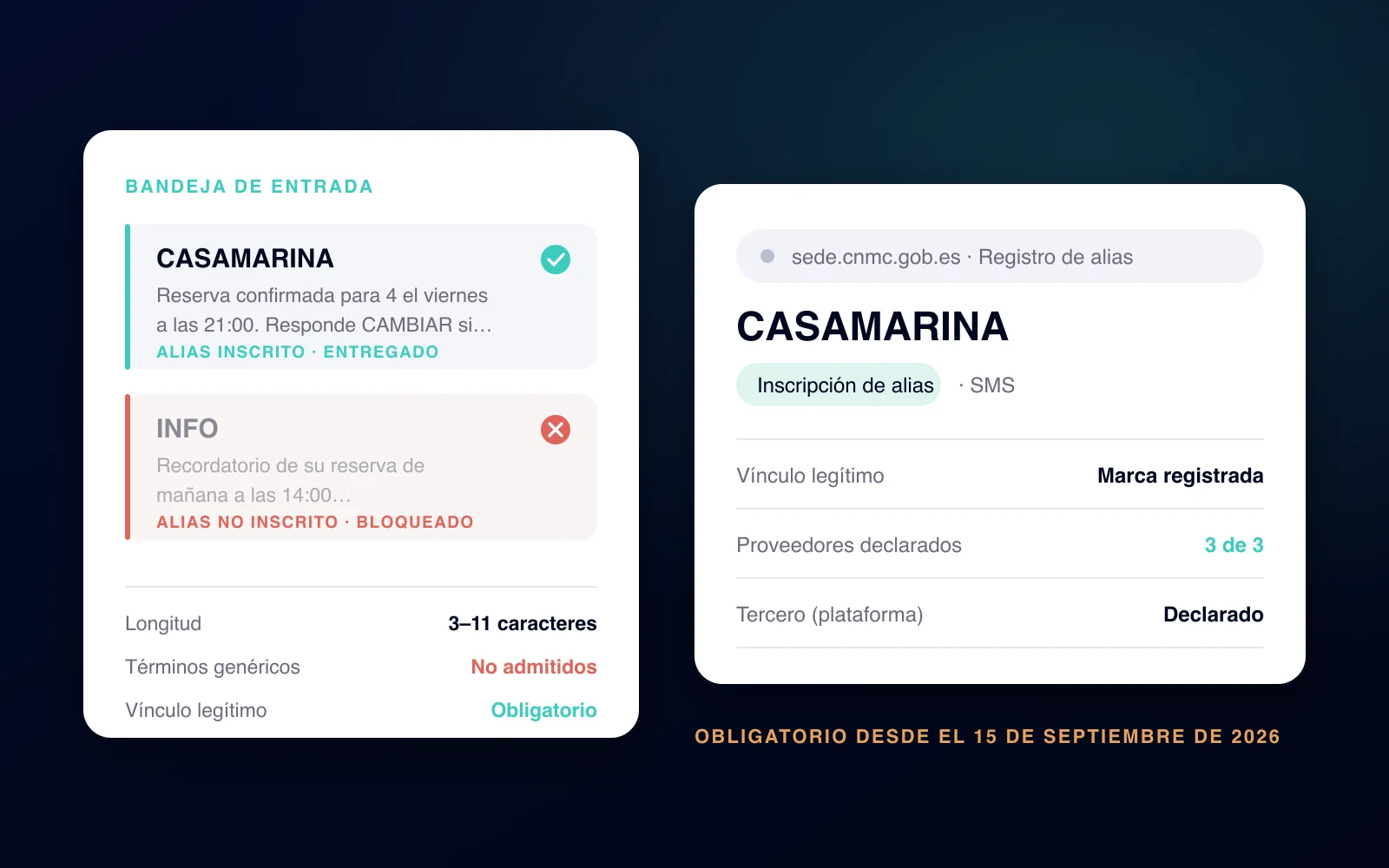
If your restaurant, hotel or campsite sends SMS and your brand name shows up on the customer's screen instead of a phone number, that name is an alias. Since 15 September 2026, Spanish operators are required to block messages whose alias is not registered with the CNMC, Spain's markets and competition authority.
This is not a recommendation or a grace period: the message is not delivered. And it does not only hit marketing campaigns — it hits booking confirmations, appointment reminders and the "your table is ready" text too. This guide explains where the rule comes from, who it applies to, what makes an alias valid and how to register one step by step.
What the alias registry is and where it comes from
An alias — or sender ID — is the alphanumeric sender of a message: the text the recipient sees instead of a phone number. "BOOKLINE", "CASAMARINA" or "HOTELSUR" are aliases.
For years nobody verified that field. Anyone could sign an SMS as if they were a bank, a parcel company or the tax authority, and that borrowed trust is exactly what makes *smishing* work: SMS fraud in which the attacker poses as a known brand so the victim clicks a link.
The alias registry closes that door. From now on, an alias can only be used by whoever proves it belongs to them, and only through the providers that owner has declared.
The regulatory trail, for anyone who wants the exact reference:
- Order TDF/149/2025, of 12 February, sets out the obligations to fight messaging fraud and hands the registry to the CNMC.
- Circular 1/2026, of 18 March (published in the BOE on 27 March 2026), regulates the alias registry: what gets registered, who can do it and how.
- Circular 2/2026, of 5 June, and Circular 3/2026, of 8 September, amend it and adjust the timetable.
- The blocking obligations are fully enforceable from 15 September 2026.
The procedure is entirely electronic and is filed through the CNMC's electronic office.
Who it applies to
Anyone sending SMS, MMS or RCS to Spanish numbers using an alphanumeric sender, regardless of where the company is based and whether it sends directly or through a platform.
In hospitality and accommodation that covers practically all outbound traffic:
- Booking confirmations and changes
- Reminders before the visit or check-in
- Operational alerts: table ready, order ready, access code
- Satisfaction surveys and marketing campaigns
The exception is anyone sending from a phone number instead of a name: there is no alias to register there. But then the customer sees a number they do not recognise, which is the very problem the alias existed to solve.
One point worth being clear about: the registration belongs to the brand owner, not to the provider. Even if you send your messages through a platform, you are the one who registers the alias.
What exactly gets blocked
There are two cases, and the second one catches people out:
- Messages with an alias that is not registered. The obvious one.
- Messages with a registered alias, but sent by a provider not authorised for that alias. The registry does not only store the name: it also stores which providers may send it.
The practical consequence of the second point is that registering the alias is not enough. If you switch sending platform tomorrow, or if your provider routes through an aggregator you did not declare, those messages are blocked even though the alias is yours and properly registered.
That is why the "Providers" step of the form — which looks like filler bureaucracy — is the one worth checking twice.
Before you start: digital certificate and legitimate link
The procedure is electronic from start to finish, so you need a valid digital certificate for whoever will sign the application.
You will also have to evidence the legitimate link: proof that the alias is rightfully yours. Any of these routes works, and it is worth having the document to hand before you start:
- Trademark or trade name: registration certificate from the OEPM or the EUIPO
- Company name: deed of incorporation or a certificate from the Commercial Registry
- Web domain: contract or certificate of domain ownership
- Responsible declaration
If the alias you use matches your registered trademark, this part is trivial. If it is an abbreviation you invented years ago and matches nothing, now is the moment to decide which link you are going to defend it with.
What a valid alias looks like
The registry does not accept any string of text. There are three rules and they are short:
- Length: minimum 3 and maximum 11 characters.
- Not numeric: aliases made up only of digits are not allowed, unless they are Spanish or international mobile numbers.
- Not generic: terms such as "INFO", "SMS", "AVISO" or "URGENTE" are out, and so are the names of public institutions if you are not their official holder.
The sensible move is to register the alias you already use, so the customer keeps seeing the same sender as always. But if that alias breaks one of the three rules, it is better to pick the new one now — and tell your team — than to find out when the application comes back rejected.
How to register your alias, step by step
The form lives in the CNMC's electronic office and is completed in a single session.
1. Access the electronic office
Go to the Telecommunications section of the CNMC's electronic office, look for the "Gestión del Registro de alias" procedure and sign in with your electronic certificate.
2. Type of application
Select "Inscripción de alias" (alias registration). The same procedure is later used to amend or withdraw what you already have on file.
3. Owner's representative
State who signs on behalf of the alias owner:
- Natural person: someone with powers of representation and a digital certificate.
- Legal person: one company representing another, when a third party handles the filing.
4. Alias
This is the substance of the application:
- Add your aliases — you can register several for the same owner in a single application.
- Select the message type (SMS).
- Select the activation date.
- Select the legitimate link that proves the alias is yours.
5. Providers
Declare every provider your messages with that alias may go out through. They are added one at a time: pick the provider from the dropdown, click "Add provider" and repeat with the next one.
This is the step worth cross-checking with whoever runs your sending, because a provider missing here is a block tomorrow.
6. Third parties: software, agency or reseller
If you do not send directly but through a platform, an agency or a reseller, declare it under "Añadir tercero" (add third party) with its person type, name, tax ID and legal representative.
If you send your SMS with Bookline
If you are a Bookline customer and send your messages through us, you do not have to work out on your own which providers to declare in the Providers step, or what details we appear under as a third party: we hand them to you, ready to paste into the form.
Message us on WhatsApp and we will send them over straight away. You can also reach us at soporte@bookline.ai and on +34 933 803 348.
What happens if you did not make it in time
The CNMC set up a transitional measure: aliases whose registration had been applied for before 15:00 (mainland Spanish time) on 14 September 2026 were pre-registered, so they keep working while the application is resolved.
Outside that window, the situation is what it is: an unregistered alias gets blocked. The registry is still open and you can file today, but until it is resolved, messages sent with that alias will not arrive.
Two things that do not work as a plan B:
- Making up another alias. A new alias is not registered either, so it has exactly the same problem.
- Waiting to see what happens. Operators apply the block automatically; there is no room for interpretation in delivery.
What does work in the meantime is leaning on the channels that do not depend on an alias: the phone and WhatsApp. If booking reminders are what worries you, WhatsApp campaigns cover that same gap without going through the registry — and with better read rates, which was the other reason to consider the switch.
SMS is a channel, not a conversation
This rule is good for everyone: an ecosystem where the sender means something is an ecosystem where your messages get read. The awkward part is the paperwork, and it is done once.
It is worth using the moment for a deeper question, though: how many of your SMS alerts exist because the customer could not find another way to talk to you? A reminder is one-way; a booking that changes, a question about the menu or a late arrival are not. That is where voice AI and WhatsApp come in, because they answer back.
If you want to go further, how to reduce no-shows at your restaurant covers the use case that shows up fastest in revenue, and what a WABA is is the WhatsApp equivalent of this article: what you have to register and why.