When a restaurant decides it is missing too many calls, the first idea is usually to hand the phone to someone else: an answering service with live receptionists. It is a reasonable instinct, and for some businesses it works well. For restaurants, three things tend to get in the way: the price at real call volumes, the hours when the calls actually arrive, and the distance between a message taken and a table booked.
This article compares the three realistic options (an answering service, a dedicated person on the phone and an AI voice agent) using published prices and public wage data, so you can run the numbers for your own restaurant.
What you are actually buying
All three options answer the phone. The differences are in what happens next:
- An answering service gives you trained receptionists in a call center who answer in your restaurant's name, follow a script, and take a message or a booking request. Most are built for law firms, clinics and contractors, where a message and a callback is the product.
- A dedicated person means moving the phone off the host stand to someone whose job during service is only the phone: a reservationist, a second host, or a manager on rotation.
- An AI voice agent is software that answers every call at the same time, holds the conversation, and, if it is integrated, writes the reservation directly into your system.
For a restaurant, the question that decides most of this is the last one. In the calls Bookline answers, 25% of guests ask a question before they book and 16% of bookings include a special request. Whatever answers the phone has to handle both and get the result into the book the team reads before service.
What each option costs
Published prices, checked in October 2026. Check the vendors' pages for current pricing before deciding.
Answering services: priced by the minute or by the call
Two of the best-known US services publish their rates:
- Ruby sells plans by minutes per month: $250 for 50 minutes, $395 for 100, $720 for 200 and $1,725 for 500.
- Smith.ai's human receptionists are priced by call: $300 a month for 30 calls, $810 for 90 and $2,100 for 300, with each extra call at $11.50, $10.50 and $8.50 respectively.
Those plans make sense for a business that gets a few calls a day. A busy restaurant can get dozens before dinner on a Friday, and every one counts, including "what time do you close?".
A dedicated person: priced by the hour
According to the Bureau of Labor Statistics, the median wage for restaurant hosts and hostesses in the US was $15.00 an hour in May 2025. Covering only the four busiest hours a day, every day, is about 120 hours a month: around $1,800 in wages, before payroll taxes, training and the shifts nobody wants to cover.
And one person still takes one call at a time. 60% of calls arrive in the two hours before service, so at peak the second and third callers still wait or hang up.
AI voice agents: usually flat or per call
AI phone agents are typically priced as a monthly fee or per call, at a fraction of a human answering service. Smith.ai's own AI receptionist, for example, starts at $150 a month, against $300 for its human plan. Restaurant-focused vendors, Bookline included, generally quote by restaurant and call volume, so ask for a price on your real numbers.
Price it on your real call volume
Book a demo: we'll show you the agent booking into your system and quote on your actual number of calls.
Book a demoA worked example: 600 calls a month
A busy restaurant receiving 600 calls a month (20 a day, more on weekends) of about two minutes each: 1,200 minutes. These are illustrative numbers; use your own call log.
- Answering service by the minute: 1,200 minutes is more than double Ruby's largest published plan of 500 minutes for $1,725, so you would be on a custom plan or paying for the extra minutes.
- Answering service by the call: on Smith.ai's 300-call human plan, 600 calls is $2,100 plus 300 extra calls at $8.50 = $4,650 a month.
- A dedicated person for the peak hours: about $1,800 a month in wages, covering four hours a day and one call at a time.
- An AI voice agent: answers all 600 calls, 24 hours a day, all at once when they overlap. Ask for a quote on 600 calls; it should be well below the answering service, or the comparison isn't worth making.
Now set those numbers against what the unanswered calls cost you today. We showed how to calculate that in how much missed calls cost your restaurant.
Coverage: who answers at 7 PM on a Friday
- Answering service: answers whenever its contract says, often around the clock. Capacity depends on the call center's staffing at that moment, and receptionists juggle many clients at once.
- Dedicated person: answers during their shift, one call at a time. Overlapping calls at peak still queue.
- AI voice agent: answers every call on the first ring, at any hour, with no queue, including the days you are closed.
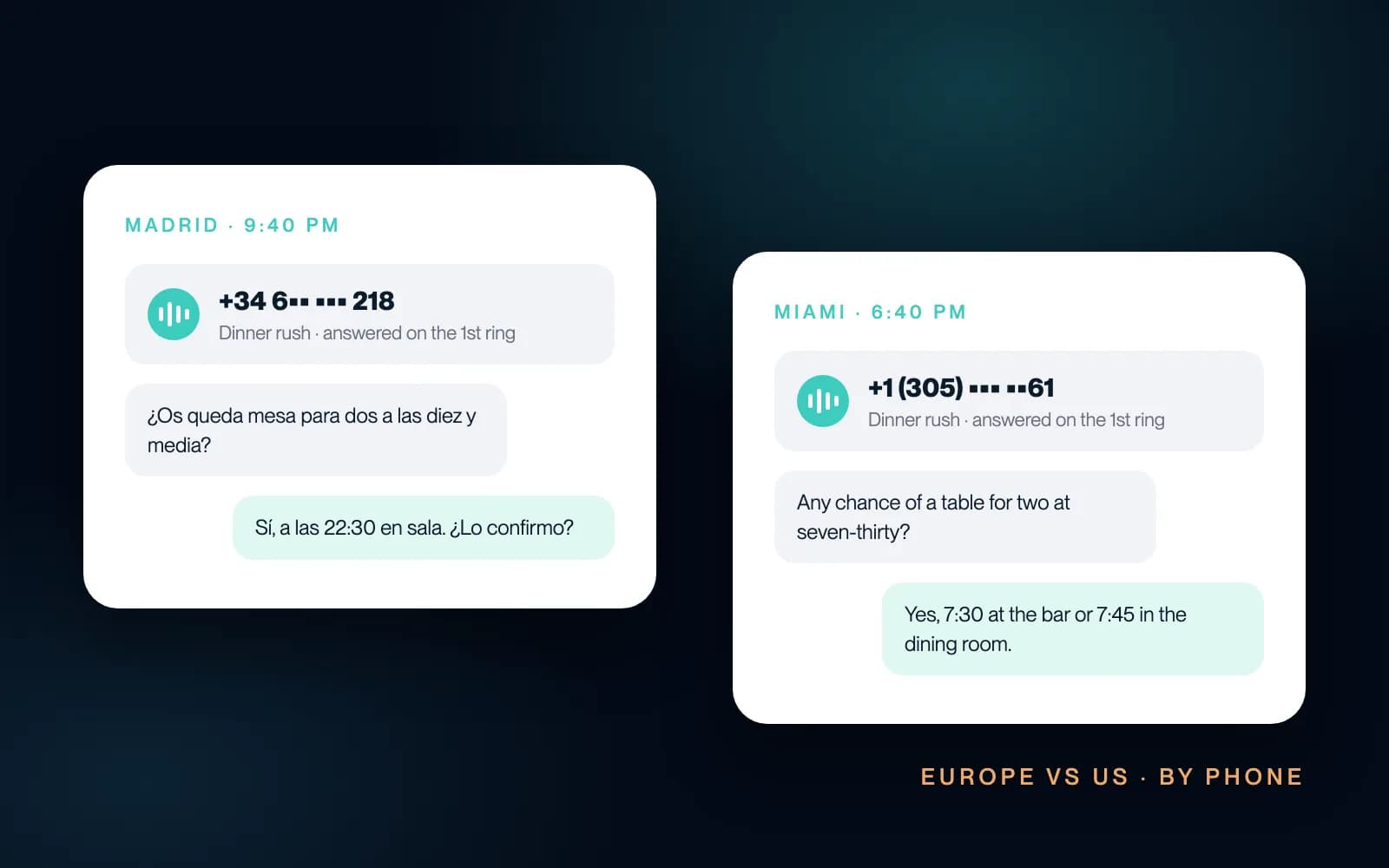
Language is part of coverage. In much of the US, a share of your callers would rather book in Spanish; an answering service may route them to a bilingual operator if one is free, while a multilingual AI agent answers in the caller's language from the first word. We covered the options in serving Spanish-speaking guests by phone.
Where the booking ends up
This is where the options really differ for a restaurant.
Most answering services take the booking request and pass it on by email, text or an app, and someone at the restaurant enters it into the reservation system later. Meanwhile, the table stays available online. That gap is where double bookings, lost allergy notes and "we have no record of your reservation" come from. Some services can access your booking software; if that matters to you, and it should, ask exactly how.
A dedicated person can book straight into the system, if they have the time between calls to do it carefully.
An integrated AI agent checks live availability and writes the reservation into your system during the call, with the special requests in the reservation itself. If you use OpenTable, we explained how that works in AI phone agents for OpenTable restaurants.
Which one fits your restaurant
- An answering service fits restaurants with low call volume and mostly simple messages, or a catering or events business where every inquiry needs a human callback anyway.
- A dedicated person fits high-end restaurants where the phone is part of the hospitality and the call volume justifies a full role, ideally with something behind them for overflow and after hours.
- An AI voice agent fits restaurants where the calls cluster at peak, most of them are reservations and questions, and the booking has to reach the system in real time. That is most busy restaurants.
Many restaurants end up combining two: an AI agent on every call, and transfers to a person for the events, complaints and requests that need one.
Frequently asked questions
What restaurants ask when comparing answering services and AI agents.
Is an AI voice agent cheaper than an answering service?
At restaurant call volumes, usually yes, because answering services charge per minute or per call and restaurants get many short calls. Compare quotes on your real monthly volume, including your busiest month.
Can an answering service book tables directly?
Some can, if they are given access to your reservation software, but many pass bookings on as messages. Ask whether the reservation appears in your system during the call or later.
Can an AI agent hand the call to a person?
A good one can, and should: it transfers calls that need your team, such as complaints or private events, with a summary of what the guest already said.
Does Bookline publish its prices?
Not on the website, because the price depends on the restaurant and its call volume. A demo includes a quote on your numbers.