Bookline grew up answering restaurant phones in Spain, Italy, France, Portugal and Latin America: more than 12 million calls for over 2,000 hospitality businesses. As we start talking to American operators, the question we get most is a fair one: does any of that apply here?
Some of it does, almost unchanged. Some of it does not. This article compares the two sides honestly, using our own European call data on one side and public US sources on the other. We have not answered US restaurant phones at scale yet, so where we draw conclusions about the US, we say so.
What is the same on both sides of the Atlantic
Four patterns from our European call data that we would expect to hold in any US restaurant, because they come from how restaurants work, not from culture:
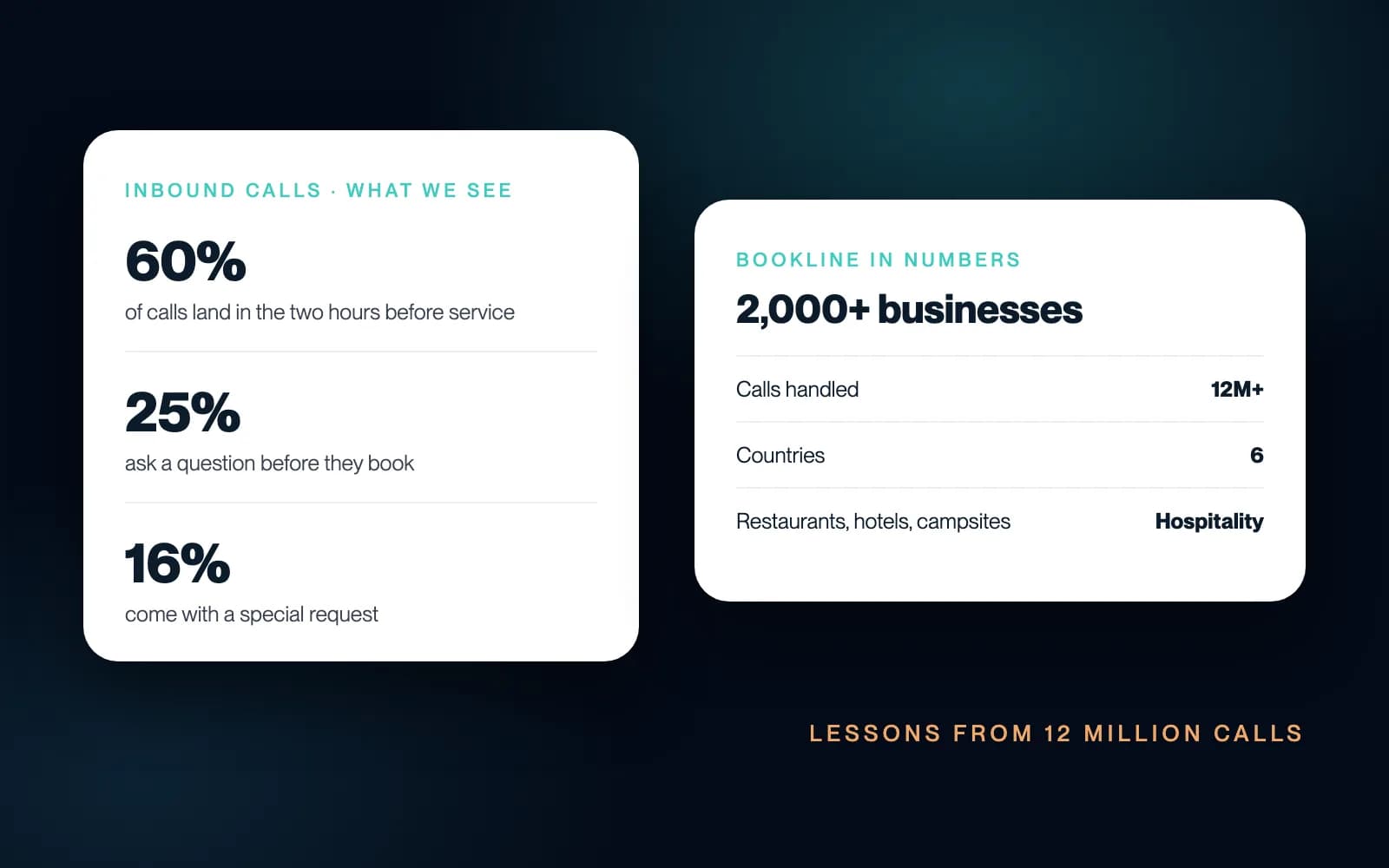
- The phone peaks right before service. 60% of calls arrive in the two hours before service, when the team is busiest.
- Callers are new guests. 80% of callers have never contacted the restaurant through any other channel.
- People ask before they book. In 25% of calls, the guest has a question first.
- Bookings come with details. 16% of reservations include a special request: a birthday, an allergy, a high chair.
The US data we could find points the same way. Slang.ai, a US AI phone vendor, reported in 2025 from its own restaurant call data that only 66% of calls come in during business hours and that 26% arrive either after hours or while another call is already ringing. Different company, different country, same problem: the phone rings when nobody can pick it up. The full European picture is in what 2,000+ hospitality businesses taught us about phone bookings.
6 differences that change how the phone works
The ones that should change how a US restaurant handles its phone.
1. The clock
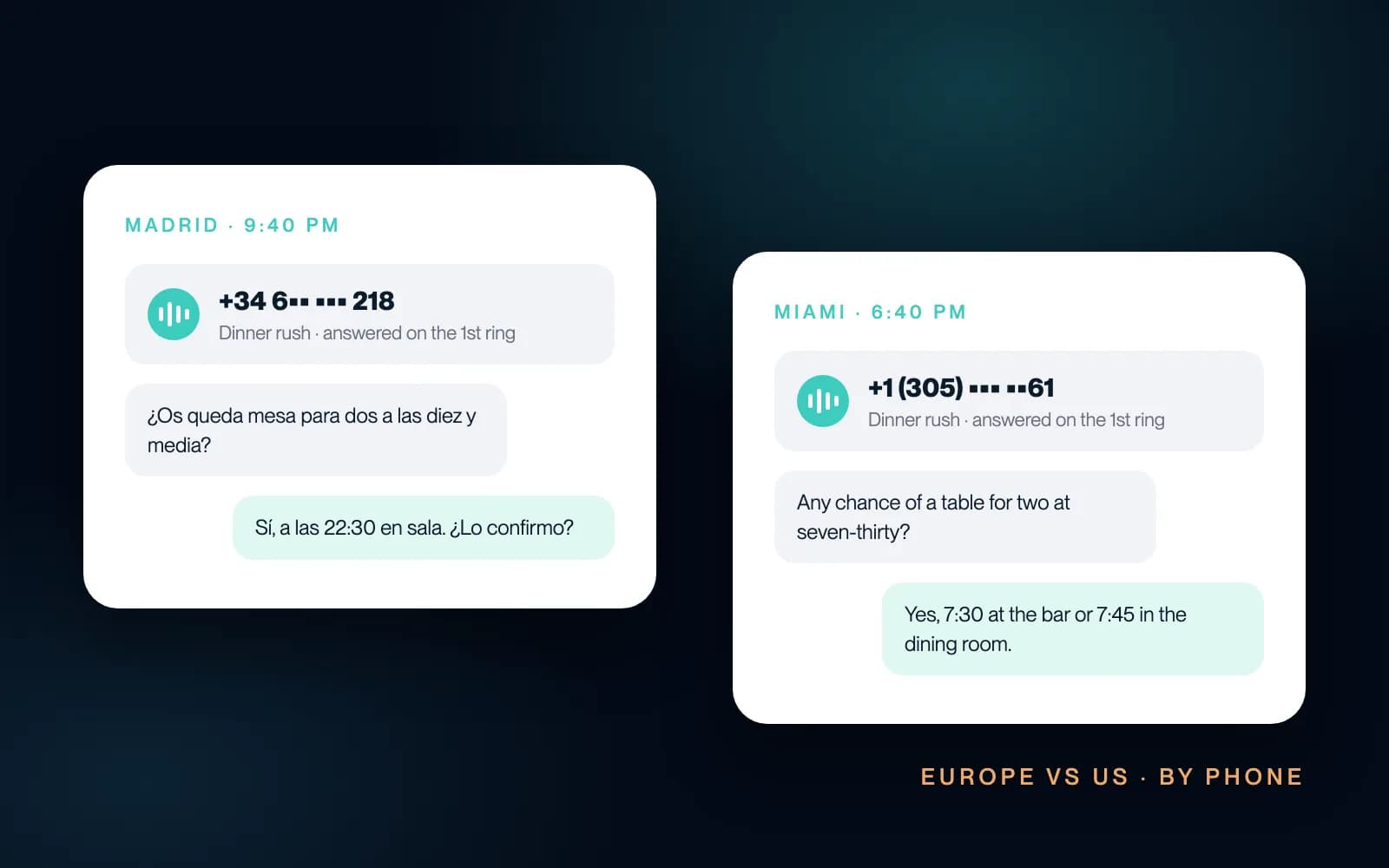
In Madrid, dinner service runs from around 9 PM and the busiest tables are booked for 9:30 or 10. In most US cities, dinner peaks hours earlier. The two-hour pre-service window exists in both places, so the call peak simply moves with it: late afternoon in the US, early evening in Spain.
The practical consequence for a US restaurant is that the phone peak often overlaps with the end of lunch clean-up, the staff shift change and pre-shift, rather than with a quiet afternoon. It is a bad time for anyone to be stuck on the phone.
2. Online booking is more established in the US
American diners have had large online reservation networks for longer. OpenTable alone lists more than 70,000 restaurants, bars, wineries and other venues worldwide, and Resy (which now includes Tock), SevenRooms and Yelp Guest Manager cover much of the rest. In much of Southern Europe, independent restaurants still take a large share of reservations by phone and, increasingly, by WhatsApp.
That does not make the phone less important in the US. It changes what the phone is for. When the easy bookings go online, the calls that remain are the ones online cannot handle: the party of twelve, tonight at 8, the allergy question, the change to an existing reservation, the guest who simply prefers to talk to someone.
3. WhatsApp versus texting
In Spain, Italy or Latin America, WhatsApp is how many guests confirm, change or ask about a booking, and restaurants treat it as a reservation channel in its own right. In the US, that role is played by text messages and by the reservation platforms' own apps. The lesson is the same on both sides: confirm the booking in writing, in the channel the guest already uses, and let them cancel by replying. It is the cheapest no-show prevention there is.
4. Five languages versus two
A restaurant in Barcelona or on the Amalfi coast gets calls in Spanish or Italian, English, French and German, mostly from tourists. A US restaurant is more likely to get two languages, every day, from locals: according to the Census Bureau's 2024 American Community Survey, 44.9 million people in the US speak Spanish at home, and 41% of them speak English less than "very well".
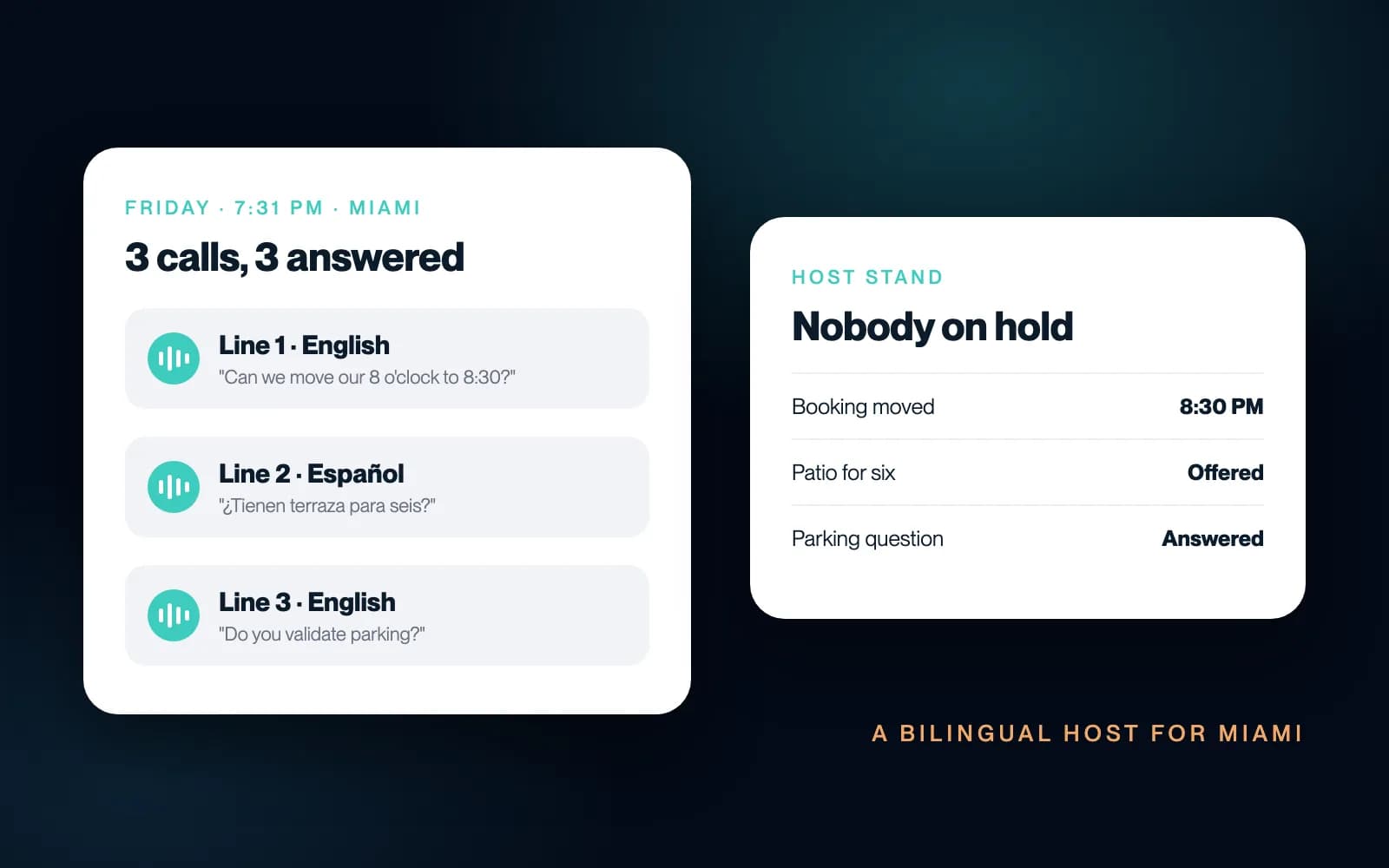
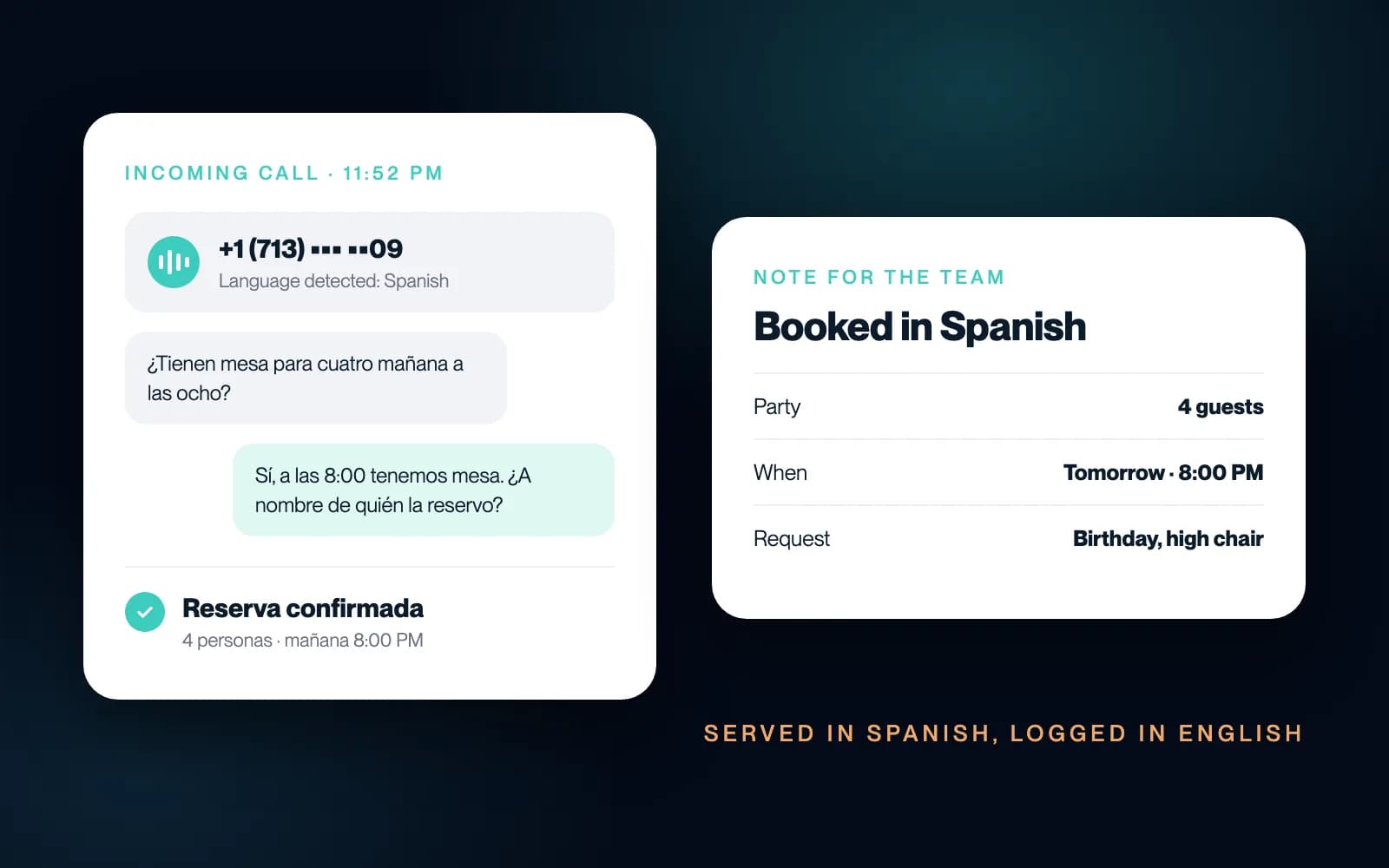
In Europe, multilingual answering is about tourism. In the US, Spanish-language answering is about your regulars and your neighborhood. We go deeper in how to serve Spanish-speaking guests by phone 24/7 and, for the most bilingual market of all, in a bilingual AI host for Miami restaurants.
5. Staffing
Restaurants on both sides are short of hands, but the US numbers are unusually well documented. The National Restaurant Association's 2026 hiring and staffing report found that 22% of operators did not have enough staff to meet demand in 2025, down from 78% in 2021 but still more than one in five. In an American restaurant, the phone usually falls on the host, who is also running the stand, the waitlist and the floor.
6. The rules on recording calls
In Europe, the GDPR governs what you do with a caller's data and requires you to tell them how it is used. In the US, call recording is governed state by state: some states, including Florida (Fla. Stat. §934.03) and California (Cal. Penal Code §632), require the consent of every party. Whatever answers your phone, a person or an AI agent, the greeting should disclose recording where the law requires it. This is not legal advice; check your state.
Same peak, your time zone
See a Bookline agent answer, check availability and book into your system, in English or Spanish.
Book a demoWhere the US is ahead: voice AI on the phone
One area where the US moved first is connecting AI phone agents directly to the reservation book. OpenTable does not answer phones itself; instead it works with voice AI partners that write into its book, and reports more than 3 million diners already seated through voice AI. In Europe, the same integrations exist with the platforms restaurants use there, such as TheFork and CoverManager, and that is how Bookline has worked from the start: the agent is only useful if the booking lands in the real book.
For a US operator, that means the question is no longer whether an AI agent can take a reservation. It is which one handles your calls best: in both languages, all at once, with your real answers, and with a clean handoff to a person when it matters.
What this means for a US restaurant
- Expect the same peak. Pull your call log and look at the two hours before service. That is where the missed calls will be.
- Treat the phone as the channel for the hard cases. Large parties, same-day requests, changes and questions: the bookings online can't take are often the most valuable ones.
- Answer in the languages your neighborhood speaks, not only the ones your staff happens to speak that night.
- Make sure every phone reservation ends up in the same book as your online ones.
- Confirm in writing and let guests cancel by replying.
If you want to see how that looks with a Bookline AI voice agent, the demo is the quickest way: you call it, it books.
Frequently asked questions
What US operators ask us about the comparison.
Do Americans still book restaurants by phone?
Yes. In a 2025 survey of 2,065 US adults conducted by The Harris Poll for Hostie, an AI phone company, 63% said they prefer calling restaurants. Online booking is widespread, but the phone remains the channel for questions, large groups, same-day tables and changes.
Is Bookline's data from US restaurants?
Not yet. Our call figures come from more than 2,000 hospitality businesses in Spain, Italy, France, Portugal and Latin America. Where we talk about the US, we use public sources and say which ones.
Which reservation systems does Bookline integrate with?
The main ones in Europe and the US, including TheFork, CoverManager, OpenTable and SevenRooms. See the full integrations list.