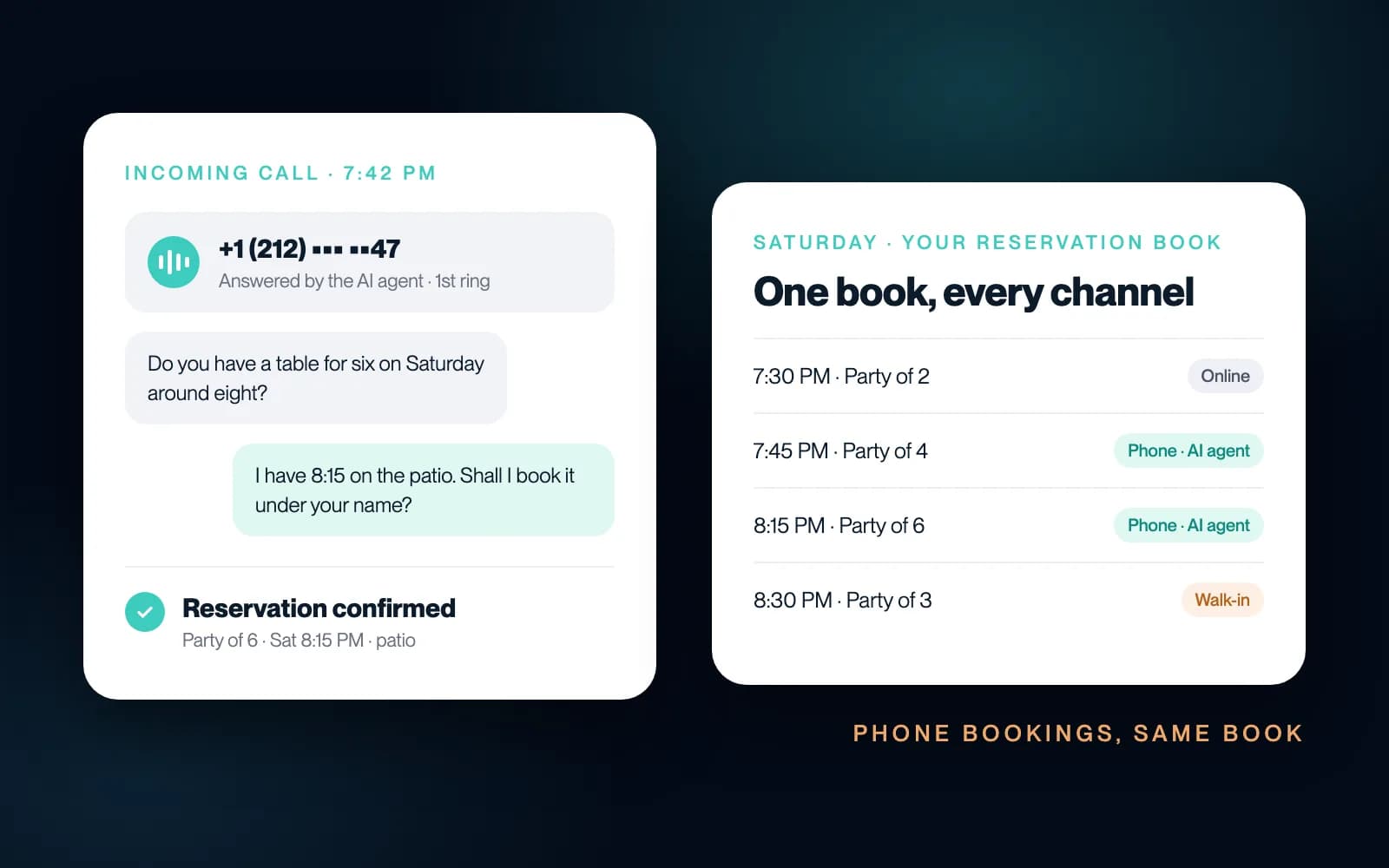
If your restaurant runs on OpenTable, your online reservations already take care of themselves. The phone does not. Someone still has to pick it up, check the book, find a table, type the reservation in and write down the birthday, usually while seating a party or running food.
An AI phone agent connected to OpenTable closes that gap: it answers every call on the first ring, checks the same availability your online guests see, and writes the reservation straight into your OpenTable book. This article explains how that works in practice, what it can and cannot do, and what to check before you pick one. Bookline is one of OpenTable's listed voice AI partners, so we describe it from our own setup.
The gap: OpenTable handles online, the phone still needs a person
OpenTable runs your online reservations, your floor plan and your guest profiles. What it does not do is pick up the phone. When a guest calls, someone on your team creates an in-house reservation by hand: open the book on the iPad or in the browser, pick the date, party size and time, look the guest up by phone number, type it in.
That works fine at 3 PM. At 7 PM, with the host seating a party of eight and two more calls ringing, it is where reservations get lost. In the data from the restaurants we serve, 60% of calls arrive in the two hours before service, which is exactly when nobody is free.
OpenTable's answer is to work with voice AI partners rather than build its own: its support page on voice AI lists the providers that connect to its reservation book, and OpenTable reports more than 3 million diners already seated through voice AI. Bookline is one of those listed partners in the United States, as well as in the UK, Spain, France, Italy, Germany, Portugal, Mexico and Latin America. According to that page, the integration is available on OpenTable's Core and Pro plans, OpenTable charges no fee to switch it on, and reservations made by the agent appear under the Partner column in your reservation reports.
How an AI phone agent works with OpenTable
Here is what happens on a typical call, step by step.
1. The call is answered on the first ring
Calls to your restaurant's number are forwarded to the agent: always, only when nobody picks up after a few rings, or only outside opening hours. You choose. The agent answers immediately, in English or Spanish depending on the caller, and takes as many calls at once as come in. Nobody is put on hold during the 6 PM rush.
2. It checks real availability in OpenTable
When the guest asks for a table for four on Saturday at 8, the agent queries availability in your OpenTable book in real time, the same inventory your online guests see. If 8:00 is full, it offers the closest options (7:45, 8:30, the bar) instead of saying no.
3. It books, and the reservation lands in your book
Once the guest picks a time, the agent creates the reservation directly in OpenTable with the guest's name, phone number, party size and notes. There is no email to copy across and no second diary: the table disappears from online availability in the same second, so a phone booking can never collide with an online one.
4. It captures the details that matter
Allergies, a birthday, a high chair, a wheelchair, a preference for the patio. 16% of the reservations we handle include a special request like these, and the agent writes them into the reservation notes so the host and kitchen see them before service.
5. It handles changes, cancellations and questions
The same call can be "can we make it six instead of four?" or "we need to cancel tonight". The agent finds the existing reservation and modifies or cancels it in OpenTable, which frees the table for someone else instead of leaving you with a no-show.
And a lot of calls are not reservations at all: in a quarter of calls, the guest asks a question before booking. Parking, dress code, corkage, kids' menu, whether you can do a group of 14. The agent answers from the information you give it, and when a request really needs a manager (a buyout, a complaint), it transfers the call with a summary.
See it book into OpenTable
Book a demo and we'll show you a call going from the first ring to a confirmed reservation in your book.
Book a demoWhat it changes for the restaurant
- No missed calls at peak. In the data from our customers, 60% of calls arrive in the two hours before service, exactly when the team is busiest. The agent takes all of them at once.
- First-time guests get a table. 80% of callers have never contacted the restaurant through any other channel. If they reach voicemail, they call the next place.
- One book. Every phone reservation is in OpenTable, with notes, so the host stand works from a single source of truth.
- The team stays on the floor. Hosts seat guests instead of reading out availability over the phone.
For reference, Grupo Ceviche, a restaurant group in Spain whose agent books into its reservation platform the same way, had 15,071 calls answered and 344 hours of phone time handed back to the team. The full story is in our success cases.
What to check before you choose an AI phone agent for OpenTable
Demos all sound good. These are the questions that separate a demo from something that holds up on a Saturday night:
- Does it write into OpenTable, or just send you a message? Some "AI receptionists" take the details and email or text them to you. That is a voicemail with better manners. You want the reservation in the book, live.
- Does it read real availability? If the agent cannot see your book, it will promise tables you do not have.
- Can it modify and cancel? Changes and cancellations are a big share of reservation calls.
- How many calls can it take at once? The answer should be "all of them".
- Does it speak Spanish? In many US cities, a meaningful share of your callers would rather book in Spanish.
- How does it hand off to a person? Ask to hear a transfer, not just a booking.
- Who owns the guest data, and is the call recorded? Florida and California, among other states, require every party's consent to record a call, so the greeting should say so where that applies.
OpenTable's own voice AI page is a good place to start the shortlist, since it only lists providers that connect to its book. Our integrations page lists the other reservation systems Bookline connects to.
Frequently asked questions
What OpenTable restaurants ask most before connecting an AI agent to the phone.
Do I need to change my phone number?
No. Calls to your existing number are forwarded to the agent, either all of them or only the ones nobody picks up. Guests keep calling the number they already know.
Do I need to stop using OpenTable?
No. The agent works on top of OpenTable. Your online reservations, floor plan and guest profiles stay exactly where they are; the agent simply becomes another way reservations get into the book.
Will guests know they are talking to an AI?
You decide how the agent introduces itself; we recommend saying plainly that it is the restaurant's virtual assistant. In our experience, guests care far more about getting a table on the first ring than about who answers.
What happens if the agent can't help?
It transfers the call to your team with a summary of what the guest wanted, so nobody has to ask twice. You set the rules for which requests go straight to a person.