44.9 million people in the United States speak Spanish at home, 13.9% of everyone aged five and over, and 41% of them speak English less than "very well", according to the Census Bureau's 2024 American Community Survey. That is more than 18 million potential guests for whom booking a table by phone in English is harder than it should be.
Most US restaurants know they have Spanish-speaking guests. Far fewer have a plan for what happens when one of them calls at 9 PM on a Friday and the person who speaks Spanish is on the line, off shift or carrying four plates. This guide covers the five realistic ways to answer the phone in Spanish, what each one costs you, and how to set up the one we think makes the most sense for most restaurants: an agent that answers in the caller's language, on the first ring, at any hour.
Why the phone matters more for Spanish-speaking guests
A phone call is the least forgiving way to deal with a language barrier. There is no time to read, no translation app, and a busy host talking fast over dining-room noise. A guest who has to struggle to make a reservation often doesn't make it: they hang up and call somewhere that answers in Spanish.
And people do call. In a 2025 survey of 2,065 US adults conducted by The Harris Poll for Hostie, an AI phone company, 63% said they prefer calling restaurants, and 69% said they were likely to give up on a restaurant that doesn't answer. Treat a vendor-commissioned survey with some caution, but the direction matches what we see in our own calls: in the restaurants we serve, 80% of callers have never contacted the venue through any other channel. The phone is how new guests arrive.
The share of Spanish speakers varies a lot by city. In the Census Bureau's 2024 survey, the share of residents aged five and over who speak Spanish at home is 67% in Miami-Dade County, 38% in Los Angeles County, 36% in Harris County (Houston), 33% in Bexar County (San Antonio) and 23% in New York City. In any of those places, a phone that only works in English is turning away a slice of demand every night.
5 ways to answer the phone in Spanish
From cheapest to set up to most complete. They are not mutually exclusive: plenty of restaurants combine two.
1. Hire bilingual hosts
The obvious answer, and where most restaurants already are. A bilingual host gives the best experience you can offer, when they are on shift and free to pick up.
The limits are the ones every operator knows: one person covers one call at a time, only during their shift, and during the dinner rush their priority is the guests at the stand, not the phone. Bilingual front-of-house staff also tend to be the people you most want on the floor, so tying them to the phone is a costly use of them.
2. A bilingual voicemail and a callback
"Para español, deje su mensaje y le devolvemos la llamada." Cheap and better than nothing, but it turns a reservation into a chore for the guest and for your team. Many callers will not leave a message at all, and the ones who do expect a callback within the hour, which nobody can guarantee on a Saturday. Callbacks also tend to happen the next morning, when the guest has already booked somewhere else.
3. An IVR menu: "Para español, oprima dos"
A phone menu routes Spanish callers to a recording or a specific line. It solves routing, not answering: if nobody who speaks Spanish is free, the call still goes to voicemail. Menus also add friction. Every option you add is another chance for the caller to hang up.
4. An answering service or call center
Outsourced answering services with bilingual operators cover more hours. The trade-offs: per-minute or per-call pricing that climbs with volume, operators who are reading a script about your restaurant rather than knowing it, and, crucially, reservations that are usually passed on by email or message instead of going straight into your reservation book. That gap is where double bookings and lost special requests come from.
5. An AI voice agent that speaks both languages
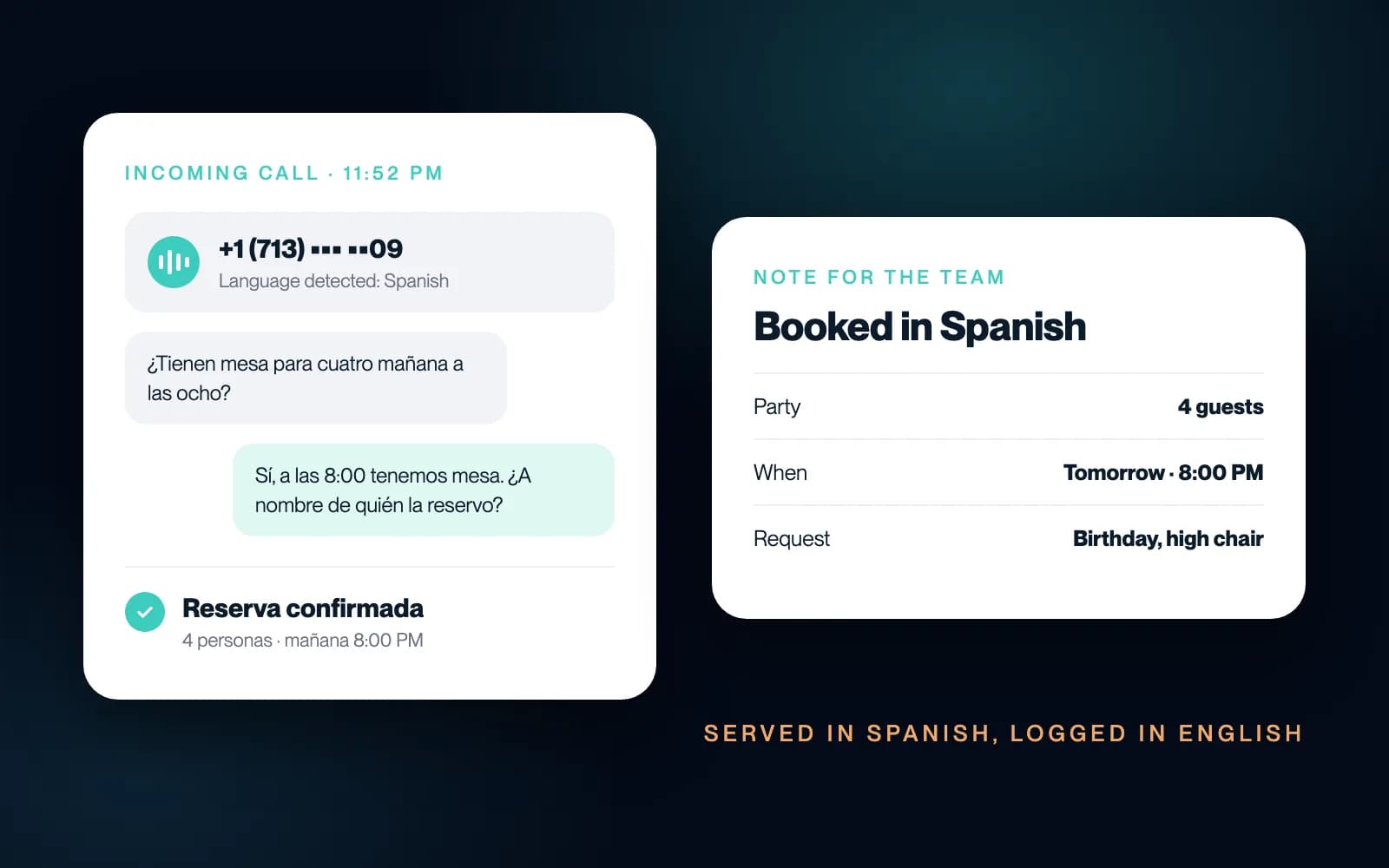
An AI voice agent answers every call on the first ring, detects whether the guest is speaking English or Spanish, and holds the whole conversation in that language: checking real availability, offering another time if the one they asked for is full, noting the allergy or the birthday, answering questions about parking or the patio, and confirming the booking. If the guest switches language halfway, the agent switches too.
Two things separate it from the options above. It takes every call at the same time, so the 7 PM rush does not create a queue. And it writes the reservation directly into your reservation system, so a Spanish-language booking looks exactly like any other one to the team at the stand. When a call genuinely needs a person, it transfers it with a summary of what has already been said.
Hear it answer in Spanish
Book a demo and call the agent yourself, in English and in Spanish, against a real reservation book.
Book a demoComparing the options
- Bilingual hosts: best experience; limited to shifts and to one call at a time; no coverage at peak.
- Voicemail and callback: almost free; slow, and most callers don't leave a message.
- IVR menu: cheap; routes calls but still needs a free Spanish speaker.
- Answering service: longer hours; per-minute cost, script-reading, bookings passed on by email.
- AI voice agent: every call answered at once, 24/7, in English or Spanish, booked straight into your system; needs a proper setup with your real information.
The pattern most restaurants land on: keep your bilingual staff for the guests in the room, and let the agent take the phone, in both languages, at every hour.
How to set up Spanish-language phone reservations
Whichever option you pick, the same five things decide whether Spanish-speaking callers end up with a table:
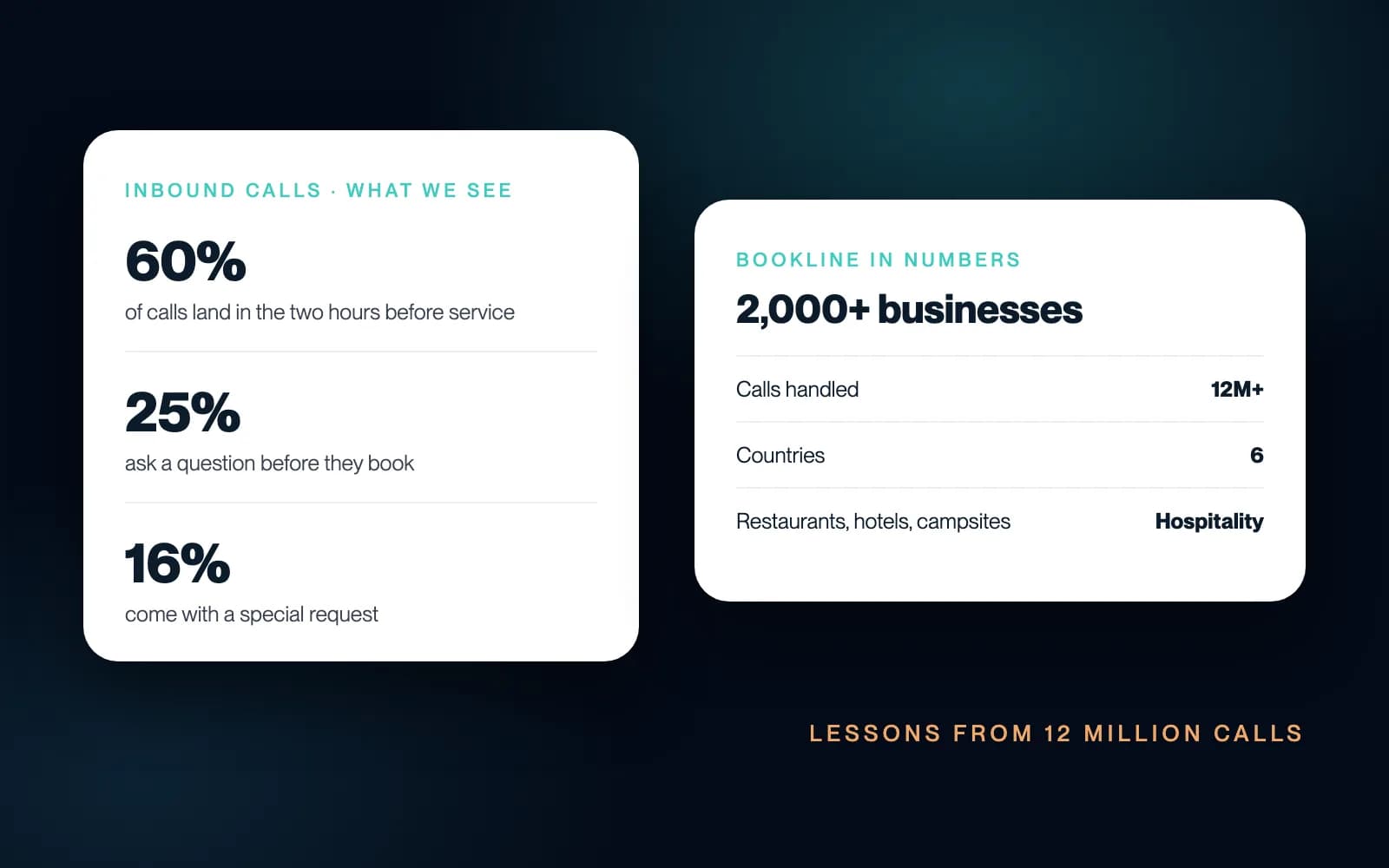
- Write your FAQ in both languages, for real. Not a machine translation of your website: the actual answers to the questions guests ask. In our data, a quarter of callers ask a question before they book, and the answer is what gets them to the booking.
- Make sure the booking reaches the book. A reservation taken in Spanish and written on a sticky note is a reservation that may not exist at 8 PM.
- Translate special requests for the team. "Sin gluten", "silla para bebé", "es su cumpleaños": whoever reads the reservation needs to understand it before service.
- Confirm in the guest's language. A confirmation text or message in Spanish cuts the "did they get my booking?" calls and gives the guest an easy way to cancel instead of not showing up.
- Mind recording consent. Some states, Florida and California among them, require every party's consent to record a call (Fla. Stat. §934.03, Cal. Penal Code §632). If calls are recorded, the greeting should say so. This is not legal advice; check the rules for your state.
Where Bookline fits
Bookline builds AI voice and WhatsApp agents for hospitality. Our agents are multilingual by default: they detect the caller's language automatically and answer in it, which is why they work for restaurants in cities where guests arrive speaking several languages.
For a US restaurant, that means English and Spanish on the same number, 24 hours a day, with every reservation written straight into the system you already use. Our agents have handled more than 12 million calls for over 2,000 businesses in Spain, Latin America and Southern Europe, where Spanish is the default language rather than the second one. If you want to know what that experience says about phone bookings in general, we wrote it up in what 2,000+ hospitality businesses taught us.
Frequently asked questions
What US operators ask most about Spanish-language phone service.
Can an AI agent tell whether a caller is speaking English or Spanish?
Yes. Bookline's voice agent detects the caller's language from the first words and responds in the same one. If the caller switches mid-call, the agent follows.
Does it understand different Spanish accents?
Our agents are built in Spain and run every day for venues in Spain and Latin America, so they handle the main varieties of Spanish. As with any speech technology, a very noisy line is harder; in that case the agent asks the caller to repeat, the way a person would.
Will my team see the reservation in English?
The reservation goes into your reservation system like any other, with the guest's name, party size, time and notes, so the team at the stand does not need to speak Spanish to seat the party.
Can it also answer on WhatsApp?
Yes. The WhatsApp agent takes the same reservations and questions in writing, in either language. For many Spanish-speaking guests, WhatsApp is the app they already use every day.