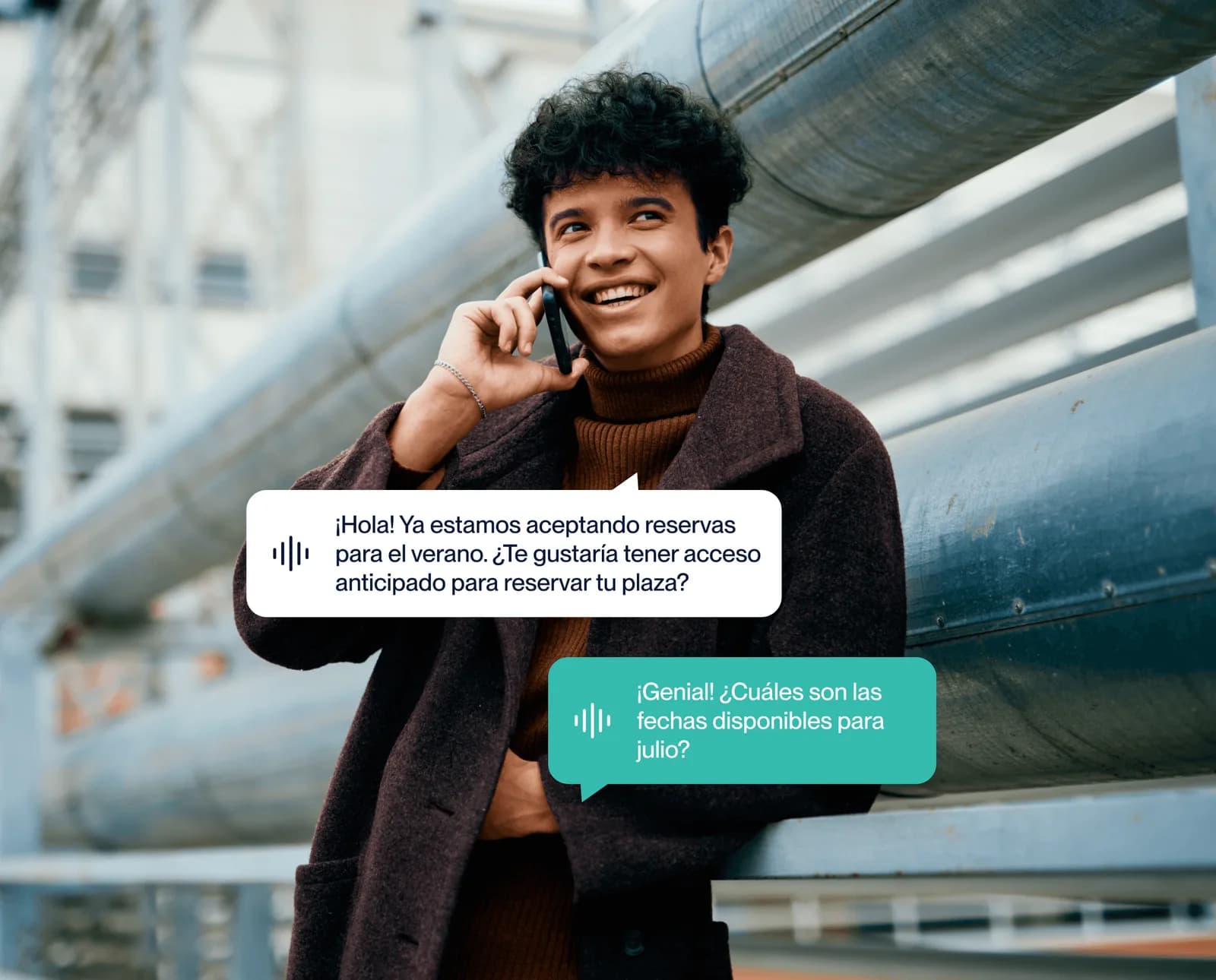
An AI voice agent is a system that answers your hotel's phone, understands what the caller wants and carries out the task — booking, changing, informing — without anyone picking up. It is not a menu-driven answering machine, and it is not magic either: some things it does better than your front desk, and some things it should not touch. This guide separates the two.
What an AI voice agent is
An AI voice agent is software that answers phone calls, holds a natural-language conversation and performs real actions in your systems: creating a booking, changing a date, confirming a check-in time.
The difference from what you already know is in those two halves. It understands what people say even when it isn't scripted — "hi, look, I wanted to change the one for next week, my wife's booking" — and it acts on the PMS rather than just taking a message.
It is not an IVR or an answering machine
An IVR ("press 1 for reservations") forces the guest to translate their problem into the menu you designed. A voice agent works the other way round: it listens to the problem and decides what to do with it.
The difference shows up in the number that matters: the share of calls resolved without handing over to a person.
It is not a chatbot with a voice
A chatbot answers text. A voice agent runs a spoken conversation, with interruptions, background noise, people changing their mind mid-sentence and accents from seven countries in the same morning.
If the distinction interests you, we go into it in chatbot, voice assistant or AI agent.
What it does well today
Four things, and it is worth being specific because the rest is sales noise.
Answering every call, at once
A front desk handles one call at a time. A voice agent handles all of them simultaneously, at 3 a.m. and on the busiest weekend of the year exactly as on a Tuesday in February.
It is the least glamorous advantage and the one that moves the most money, because a hotel's call peak lands precisely when the front desk is busiest.
Booking, changing and cancelling in the PMS
Checking real availability, applying the right rate, creating the booking and sending the confirmation. And the reverse: moving a date, changing the party size, cancelling under your policy.
When this genuinely works, the call stops being an admin task somebody has to key in afterwards.
Answering the same questions as always
Check-in times, whether pets are allowed, whether there is parking and what it costs, whether breakfast is included, how to get there from the airport.
In most hotels these questions are the bulk of phone volume and none of them needs human judgement.
Handing over to a person when it should
A good agent knows when it is not its turn: a complaint, a request outside policy, a large group, somebody getting annoyed.
The goal is not that it never transfers a call. It is that when it does, the context arrives with it.
What it does not do
This is the part almost no vendor tells you, and it is what determines whether the rollout goes well.
It does not improvise beyond what it knows
If nobody told it the cancellation policy for the non-refundable rate in high season, it does not invent one: it hands over. That is the right behaviour, but it means the configuration work is real and the quality of the result depends on the quality of what you feed it.
It does not do consultative selling
Convincing an undecided family that the suite with a terrace is worth it, picking up that someone is celebrating something and offering the detail that closes the sale: that is still your team.
What the agent does is free up front-desk time so that kind of conversation can happen at all.
It does not fix a badly configured PMS
If your rates are loaded wrong or inventory doesn't reconcile, the agent will reproduce the error faster and to more people. Automation amplifies whatever sits underneath, in both directions.
When it makes sense and when it doesn't
The useful question is not "would this be good for us?" but "do we have the problem it solves?". Three signs that you do:
Signs it is worth it
You don't know how many calls you miss. If nobody on the team can tell you last month's unanswered-call count, it is almost certainly high.
Your front desk is one or two people. The smaller the team, the more each interruption costs and the more 24/7 coverage is worth.
You have sharp seasonality. If high season triples your call volume, hiring for the peak is expensive and training for six weeks rarely pays back.
Signs it is not yet
Your phone volume is genuinely low. If you get five calls a day and answer all of them, the problem is somewhere else.
Your PMS has no API or integration. With no connection to the system, the agent informs but cannot transact, and half the return disappears.
Your product sells by talking. A very small, very relational hotel, where the call *is* the experience, has little to gain and something to lose.
How it integrates with your PMS
Without integration, a voice agent is an expensive answering machine. With it, it is a sales channel.
The connection runs against the PMS or the channel manager, and what to verify before signing is concrete: whether it can read live availability, whether it can write the booking (not just leave a note), whether it respects your rates and restrictions, and what happens when the PMS doesn't respond.
Integrations lists the systems we connect to today. If yours isn't there, the right question for your PMS vendor is whether they expose a booking API, and on what terms.
What it costs and how to measure it
Pricing is usually framed per call volume or as a monthly subscription, and against the cost of a front-desk shift it comes out a fraction. But that is not the calculation that decides.
The calculation that decides is this: how many calls go unanswered today, what share of them were a booking, and what your average booking is worth. A hotel missing six calls a day, converting one in four, with an average value of 180 euros, is leaving around 8,000 euros a month on the table.
That number — yours, not this one — is what belongs on the table. And it is the same number that explains why the phone is the worst-measured direct booking channel in the industry.
Frequently asked questions
Can guests tell they are talking to an AI?
On most calls, yes — and it isn't a problem: what people reject is not talking to a machine, it is not getting their issue resolved. An agent that answers on the first ring and resolves in 40 seconds scores better than a voicemail box.
Which languages does it handle?
Current agents handle several languages on the same line and switch based on what they hear. For a hotel with international guests this is often the most immediate gain, because it covers languages your staff doesn't speak.
How long does it take to go live?
The technical part is quick. What sets the timeline is content: gathering policies, rates, exceptions and edge cases. The better documented your hotel is, the sooner it is in production.
What happens to calls it can't resolve?
They transfer to the front desk with the conversation's context attached. The metric to watch is not how many it transfers, but whether those transfers arrive half-solved or from scratch.
Where to start
Before looking at vendors, measure one week: how many calls come in, how many are answered, which time slots leak. That number alone changes internal conversations.
If you want to hear an agent answering a hotel's phone, AI for hotels has the full case, and voice agent covers how it works underneath. And if your hotel is heading towards operating without a desk, the logical next step is hotel without reception.