The problem AI solves first: the call that no one answers
There is a critical moment that repeats in almost every successful restaurant: the phone rings during lunchtime service, amidst the chaos of the dining area, and no one can answer it. That call was a reservation for four. And the next one too.
Bookline estimates that between 12% and 15% of unanswered calls can be recovered with AI, which directly translates into more confirmed reservations and more turnover. In 2024, Bookline generated more than 100 million euros in confirmed reservations by managing over 12 million calls in 1,200 establishments in the HORECA sector.
How does the voice assistant with AI work?
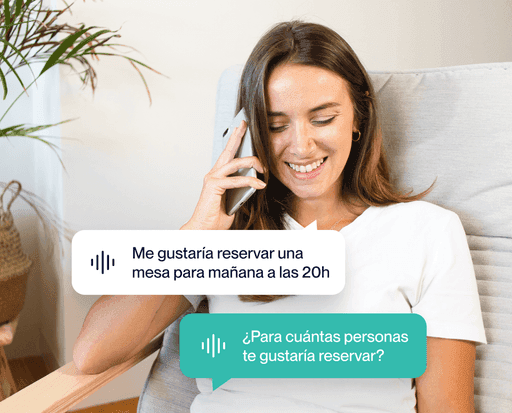
It's not an answering machine or an options menu. It's a real, smooth, and natural conversation, available 24 hours a day, 365 days a year.
- Multilingual: It detects the customer's language from the first word (Spanish, English, French, Italian, German, Portuguese) and responds automatically.
- Scalable: It can handle between 100 and 200 calls simultaneously, even with background noise.
- Resolute: * Confirms availability in real-time connected to your booking engine.
Proposes alternatives if there is no table on the requested date.
Manages changes, cancellations, and sends reminders to reduce no-shows.
WhatsApp in 2026: It's No Longer Optional
In 2026, WhatsApp is the preferred communication channel. Many customers, especially younger ones, prefer to text rather than call. With integrated AI in WhatsApp, restaurants can:
- Automate requests: Answer questions about hours, location, or availability of dishes.
- Mass personalization: Recommend menus based on preferences or send birthday greetings and special offers.
- Centralized control: For restaurant groups, it allows a single control point for all establishments with brand consistency and complete traceability.
What type of restaurant makes sense?
Request a demoFrom tool to infrastructure: What has changed this year
Two or three years ago, implementing AI was an "innovation project". Today, AI is indistinguishable from good service. The big leap of 2026 is predictive learning: systems no longer just react, but anticipate.
Learn from each interaction to improve the next.
Detect patterns of no-show and act before they happen.
Personalize the conversation with recurring customers by recognizing their previous preferences.
Conversational AI is not exclusive to large chains. Its flexibility makes it ideal for:
- High-volume restaurants: They manage hundreds of reservations without overwhelming the team.
- Restaurants with reduced hours: The assistant covers 100% of the time when the establishment is closed.
- Restaurant groups: Coordinates multiple locations and offers internal alternatives if one is full.
- International clientele: Eliminates any language barrier instantly.
- Seasonal businesses: Scales service in August without the need for extra hiring for the phone.
Implementation: No technical complications
One of the usual obstacles is thinking that technology is complex. With Bookline, the process is smooth:
- Business analysis: The model, schedules, and communication tone are studied.
- Assistant design: It is configured how it greets and what questions it manages.
- Technical integration: Connection with engines like CoverManager, OpenTable, Last.app, etc.
- Testing and activation: Thorough testing before going into production.
- Monitoring: The system continuously improves with each interaction.
The competitive advantage narrows each month
Artificial intelligence does not come to replace human warmth, but to ensure that the team can dedicate themselves to it 100%. The gap between those who use it and those who do not is measured today in lost reservations and poorly utilized staff hours.
Check it yourself before deciding
The best way to understand it is to experience it. Call one of the Bookline assistants as if you were a real customer and check their fluency.
Request your free demo with Bookline — No commitment. Just one call can change how you manage your restaurant.